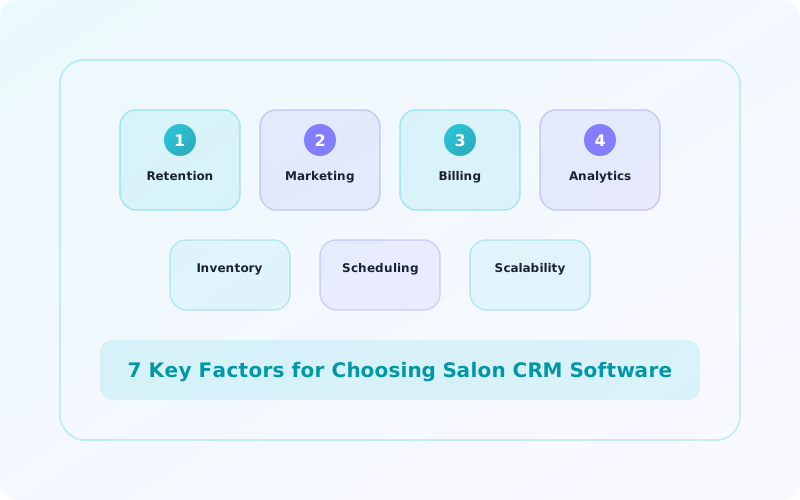
7 Key Factors When Choosing Salon CRM Software
Choosing the right Customer Relationship Management (CRM) software for your salon is one of the most consequential decisions you will make as a business owner. The right platform can transform your operations — automating appointment reminders, tracking client preferences, streamlining billing, and delivering data-driven marketing campaigns that keep clients coming back. The wrong choice, on the other hand, leads to wasted time, frustrated staff, and a system nobody wants to use.
With dozens of salon CRM options on the market, each promising to be the perfect solution, how do you separate genuine value from marketing hype? This guide breaks down the seven key factors you must evaluate before making your decision. Whether you run a single-chair studio or a multi-branch chain across India, these criteria will help you choose software that fits your business today and scales with you tomorrow.
The best salon CRM is not the one with the most features — it is the one your team will actually use. Prioritize ease of adoption, mobile accessibility, and India-specific functionality like WhatsApp integration and GST-compliant billing.
1. Client Retention & Relationship Management Features
At its core, a salon CRM exists to help you build stronger relationships with your clients. The most valuable platforms go far beyond a simple contact list. They create a 360-degree view of each client, capturing every interaction, purchase, and preference in one searchable, accessible place that any staff member can reference.
Look for a CRM that stores detailed client profiles including service history, product preferences, allergies or sensitivities, birthday dates, anniversary visits, and communication preferences. This level of detail enables your staff to deliver a truly personalized experience — greeting a client by name, remembering their favourite stylist, and recommending services based on past visits. When a client calls to book, your receptionist should see their complete history within seconds.
Retention features should also include automated birthday and anniversary offers, loyalty program integration, and re-engagement campaigns for clients who have not visited in 60 or 90 days. Studies show that increasing client retention by just 5% can boost profitability by 25% to 95%. A CRM that actively supports retention is not a luxury — it is a revenue centre. For a salon generating ₹15 lakhs per month, that 5% retention improvement represents ₹3.75 to ₹14.25 lakhs in additional annual profit.
- Detailed client profiles with visit history and product preferences
- Automated birthday and anniversary promotions with booking links
- Loyalty points and rewards program management with redemption tracking
- Re-engagement campaigns for clients inactive 60+ days
- Service preference tracking enabling personalized recommendations
- Client communication log capturing every interaction across channels
- Allergy and sensitivity notes visible at time of booking
2. Marketing Automation & Communication Tools
Manual marketing is time-consuming and prone to error. A modern salon CRM should include built-in marketing automation that lets you create, schedule, and track campaigns without leaving the platform. This eliminates the need for separate email marketing tools, SMS gateways, and social media schedulers — consolidating everything into one system.
The most critical automated communication is appointment reminders. No-shows cost the average Indian salon ₹15,000 to ₹30,000 per month in lost revenue. A good CRM sends automated SMS and WhatsApp reminders 24 hours and 1 hour before each appointment, dramatically reducing missed visits and the staff time spent on manual confirmation calls.
Beyond reminders, audience segmentation tools let you group clients by visit frequency, average spend, preferred services, or location. This enables targeted campaigns — for example, sending a discount on hair colour services exclusively to clients who have not booked a colour treatment in three months. Swalook's CRM allows you to build these segments in minutes and deploy campaigns across SMS, email, and WhatsApp from a single dashboard, with built-in analytics to track every campaign's performance.
- Automated SMS, email, and WhatsApp appointment reminders with confirmation buttons
- Audience segmentation by behaviour, spending, service preference, and location
- Drag-and-drop campaign builder with pre-designed templates
- Post-visit follow-up sequences and automated review requests
- A/B testing capabilities for subject lines and message timing
- Real-time campaign analytics showing open rates, click rates, and booking conversions
- WhatsApp broadcast integration for rich media campaigns
3. Appointment Scheduling & Calendar Management
Efficient appointment scheduling is the backbone of any salon operation. Your CRM should offer a drag-and-drop calendar interface that makes it easy to book, reschedule, and cancel appointments. Look for features like real-time availability display, multi-staff scheduling, waitlist management, and online booking that syncs instantly with your internal calendar.
Online booking is particularly important in the Indian market, where clients increasingly expect the convenience of booking outside business hours. A CRM with a client-facing booking portal or widget reduces phone call volume for your front desk staff and captures bookings 24/7, including after-hours bookings that would otherwise be lost.
For multi-branch salons, the system should support centralized or per-branch scheduling, allowing clients to book at their preferred location while giving management a unified view of occupancy across all branches. Staff scheduling features should also include break management, leave requests, and shift swapping.
4. Billing, Invoicing & Payment Integration
Your salon CRM should handle the entire billing cycle — from generating GST-compliant invoices to processing payments and tracking outstanding dues. In India, GST compliance is non-negotiable, and your software must generate invoices that meet government requirements, including HSN codes, GST rates, and digital signature capabilities.
Look for features including multiple payment method support (cash, card, UPI, wallet), split payments for group visits, package and membership billing, discount and coupon application, and digital invoice delivery via email or WhatsApp. Integration with popular payment gateways like Razorpay, PayU, or PhonePe is essential for seamless transactions. The best platforms also handle partial payments, refunds, and credit notes.
A comprehensive billing module also provides insights into revenue trends, average ticket size, and service-wise profitability — data that is invaluable for pricing decisions and promotional planning. Daily and monthly sales reports should be generated automatically and accessible from any device.
5. Inventory & Expense Management
Salons carry significant inventory — from hair colour and styling products to skincare lines and retail merchandise. A CRM with integrated inventory management helps you track stock levels across multiple categories, set automated reorder alerts when products fall below minimum thresholds, and monitor supplier performance and pricing.
Expense tracking is equally important. The best salon CRMs allow you to log operational expenses — rent, utilities, product purchases, staff salaries, marketing costs — and categorize them for tax preparation and profitability analysis. When inventory and expense data live in the same system as your sales data, you get a complete picture of your margins down to the individual service level.
6. Reporting, Analytics & Business Intelligence
Data-driven decision-making separates thriving salons from those that struggle. Your CRM should provide dashboards and reports that answer key business questions: Which services generate the most revenue? Which staff members have the highest booking rates and client satisfaction scores? What is your client retention rate month-over-month? Which marketing campaigns drive the most appointments at the lowest cost per acquisition?
Look for a CRM with customizable dashboards, exportable reports, and visual analytics that make trends easy to spot. Advanced platforms offer predictive analytics that forecast demand based on historical data, helping you optimize staff scheduling and inventory purchasing. Real-time dashboards accessible on mobile ensure you can monitor your business from anywhere.
- Daily, weekly, and monthly revenue and profitability dashboards
- Staff performance metrics including utilization rate and booking conversion
- Client retention and churn analysis with cohort tracking
- Marketing campaign ROI tracking per channel and per segment
- Service and product performance analytics with margin analysis
- Custom report builder for specific business questions
- Mobile-friendly dashboards for on-the-go monitoring
7. Scalability, Support & Total Cost of Ownership
The CRM you choose today should still serve you five years from now. Evaluate the platform's scalability: Can it handle multiple branches? Does it support an unlimited number of clients and appointments? Is there a clear upgrade path as your business grows from a single outlet to a multi-location chain?
Customer support quality is another critical factor. When your system goes down during peak hours, you need responsive support — ideally with India-based teams who understand local business needs and regulatory requirements. Look for providers offering phone, email, and chat support, along with comprehensive onboarding and training resources including video tutorials and documentation.
Finally, calculate the total cost of ownership. Beyond the monthly subscription, consider setup fees, training costs, payment gateway charges, and any premium feature add-ons. The cheapest option is rarely the most cost-effective when you factor in lost productivity from poor usability or limited functionality. Swalook offers transparent, all-inclusive pricing with no hidden fees and a 14-day free trial so you can evaluate the platform risk-free with full access to all features.
Making the Right Choice for Your Salon
Selecting a salon CRM is an investment in your business's future. By evaluating potential platforms against these seven criteria — retention features, marketing automation, appointment scheduling, billing, inventory management, analytics, and scalability — you can make a confident decision that will serve your salon for years to come. Take the time to request demos from shortlisted vendors, involve your staff in the evaluation process, and test real-world workflows during free trial periods.
Remember: the best CRM is one your team will actually use. Prioritize demos and free trials to test real-world usability before committing. Swalook offers a 14-day free trial with full access to all features, including personalized onboarding support, so you can see exactly how the platform works in your salon before making any commitment.
Another important consideration is how well the CRM integrates with your existing tech stack. Does it connect with your website for online booking? Can it sync with Google Calendar or Apple Calendar for staff scheduling? Does it offer an API or webhook support for custom integrations? The more seamlessly a CRM fits into your existing workflow, the faster your team will adopt it and the sooner you will see return on your investment. Most modern salon CRMs offer pre-built integrations with popular tools, but the depth and quality of these integrations vary significantly between providers.
Training and onboarding support is often an overlooked factor that can make or break your CRM implementation. Even the most feature-rich platform will fail if your team does not know how to use it effectively. Look for providers that offer personalized onboarding sessions, comprehensive video libraries, written documentation, and responsive customer support during your first 30 to 60 days of usage. Swalook provides dedicated onboarding managers who work directly with your team to ensure a smooth transition, including data migration from your existing system and hands-on training at your salon location.
Book a free demo with Swalook's team to see how our all-in-one platform addresses each of these seven factors. No pressure, just a personalized walkthrough tailored to your salon's specific needs and business size.